
What Chronoworking Really Means
I remember a period in my career when I’d block out my mornings for deep work because that’s what every productivity book told me to do, only to find my best thinking actually arrived in the early evening, often on a walk after the workday had technically ended. It took me a while to stop treating that as a failure of discipline rather than simply a different rhythm.
Have you ever noticed that some mornings everything seems to flow effortlessly, while on other days your best ideas arrive long after lunch?
Many people are changing industries, exploring side projects, returning to study, freelancing, or creating entirely new career paths that did not exist a decade ago. What once looked like a
straight ladder now resembles a series of stepping stones.
Chronoworking offers another way of thinking.
Rather than expecting every person to perform at their best between nine and five, chronoworking encourages you to understand your natural energy patterns and organise your work around them where possible.
It is not about working longer hours or squeezing more into your day. It is about recognising when your mind is naturally sharper or more reflective, and matching your tasks to those moments.
For people with flexible schedules, remote roles, or supportive workplaces, this approach can lead to more satisfying and sustainable ways of working. Even in structured environments, becoming aware of your energy patterns can help you make better choices throughout the day.
The Basics of Circadian Energy and Focus
Your body follows a natural 24-hour cycle known as your circadian rhythm. This internal clock influences much more than your sleep. It also affects your alertness, concentration, mood, and energy levels.
That is why you might feel ready to tackle complex work at one time of day but find the same task much harder a few hours later.
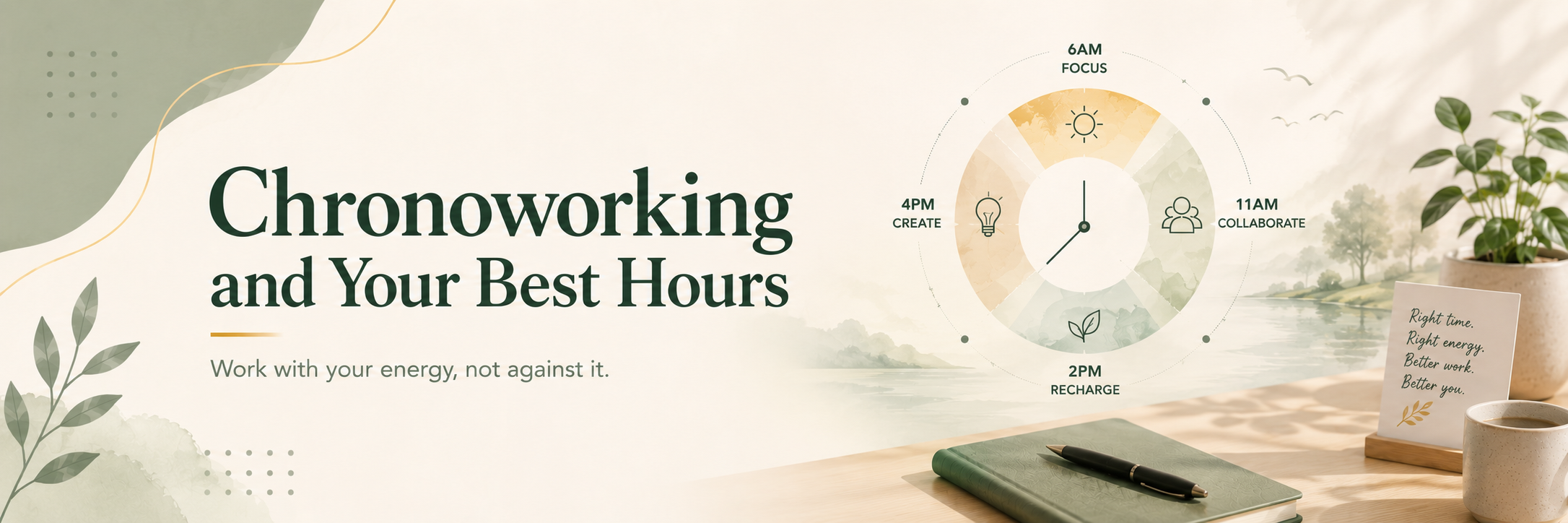
While everyone’s rhythm is different, many people notice patterns such as:
● A period of high focus for deep thinking and problem solving.
● A steady phase that suits meetings, collaboration, or routine work.
● A quieter period when rest or lighter tasks feel more manageable.
Instead of fighting these natural shifts, chronoworking encourages you to work with them.
This does not mean every day will feel perfectly balanced. Life, responsibilities, and workplace expectations all play a role. The goal is simply to notice your patterns and make small adjustments where you can.
Over time, these adjustments can help reduce mental fatigue and make work feel more aligned with your natural rhythm.
Map Your Best Working Hours for the Week
Understanding your energy begins with observation.
For the next week, take a few moments each day to notice when you feel most focused, creative, and energised. You may discover patterns you have never paid attention to before.
As you reflect, consider questions like:
● When do I solve problems most easily?
● When do creative ideas come naturally?
● What time of day do routine tasks feel least demanding?
● When do I usually need a break to recharge?
Once you recognise these patterns, you can begin matching your work to your energy.
If you know your focus is strongest in the morning, reserve that time for meaningful projects. If your energy dips after lunch, use that period for emails, administrative work, or short meetings where possible.
You may not have complete control over your schedule, but even small changes can make your day feel more manageable and rewarding.
Final Thoughts
Productivity is not about pushing yourself to perform at the same level every hour of every day.
Your energy naturally rises and falls, and learning to work with those rhythms can help you feel more focused and more connected to the way you work best.
Chronoworking is ultimately about self-awareness rather than perfection. The more you understand your own patterns, the easier it becomes to create a way of working that supports both your wellbeing and your goals.
If you would like to explore your own energy patterns, The Breakthrough Journal includes reflective prompts to help you identify your most productive hours. For ongoing conversations about creating a more sustainable and fulfilling career, join our Breakthrough Sessions community and explore upcoming sessions here: JOIN NOW